Codependency — From Losing Yourself to Coming Home
Session 164 · 16 August 2026 · Codependency · Losing yourself · Coming home
Somewhere along the way, for many of us, our attention left us — and went to live in someone else. It wears very different faces: the one who says yes while something inside quietly says no. The strong one who holds everyone, and goes blank when asked what they need. The one who cannot rest until the other person is okay with them again. And sometimes, the face of needing no one at all. Different lives, one movement — and slowly, quietly, we go missing from our own.
This session turned toward that movement gently. We named where it began — a child in a world where staying loved, or staying safe, depended on reading someone else. Becoming brilliant at knowing what everyone else feels, and paying for it with the other thing: knowing what we ourselves feel. Not weakness. Intelligence, and love, doing their best. Because caring for the people we love was never the wound. Vanishing inside the caring is.
And we went one layer deeper — to the belief that formed underneath the pain. "I only matter when I am needed." "My needs are too much." "If I stop holding everything, I will be left." In the guided work, we invited the pain and the belief to release together, from the same place — only what was ready, and not one drop more. For some, the work opened a much earlier layer still — very early, even ancestral pain the body has carried quietly. If that was the door that opened for you, know that this thread will have its own space in a coming session.
Whatever came up for you — a clear meeting, a small softening, or a voice that said "not today" — that was the right answer. The recording is here for you to return to, as many times as this needs.
This session has two parts. You can watch them together in one sitting, or return to each separately — both are complete on their own. Jump directly to any chapter using the timeline markers inside the YouTube player below
Part 1
Teaching & opening meditation
• Welcome and grounding
• Opening meditation
• Psychoeducation
Starts at 00:00 15 Min
Part 2
Guided inner work & sound healing
• IFS experiential
• Sound healing
• Closing
Starts at 15:00 45 Min
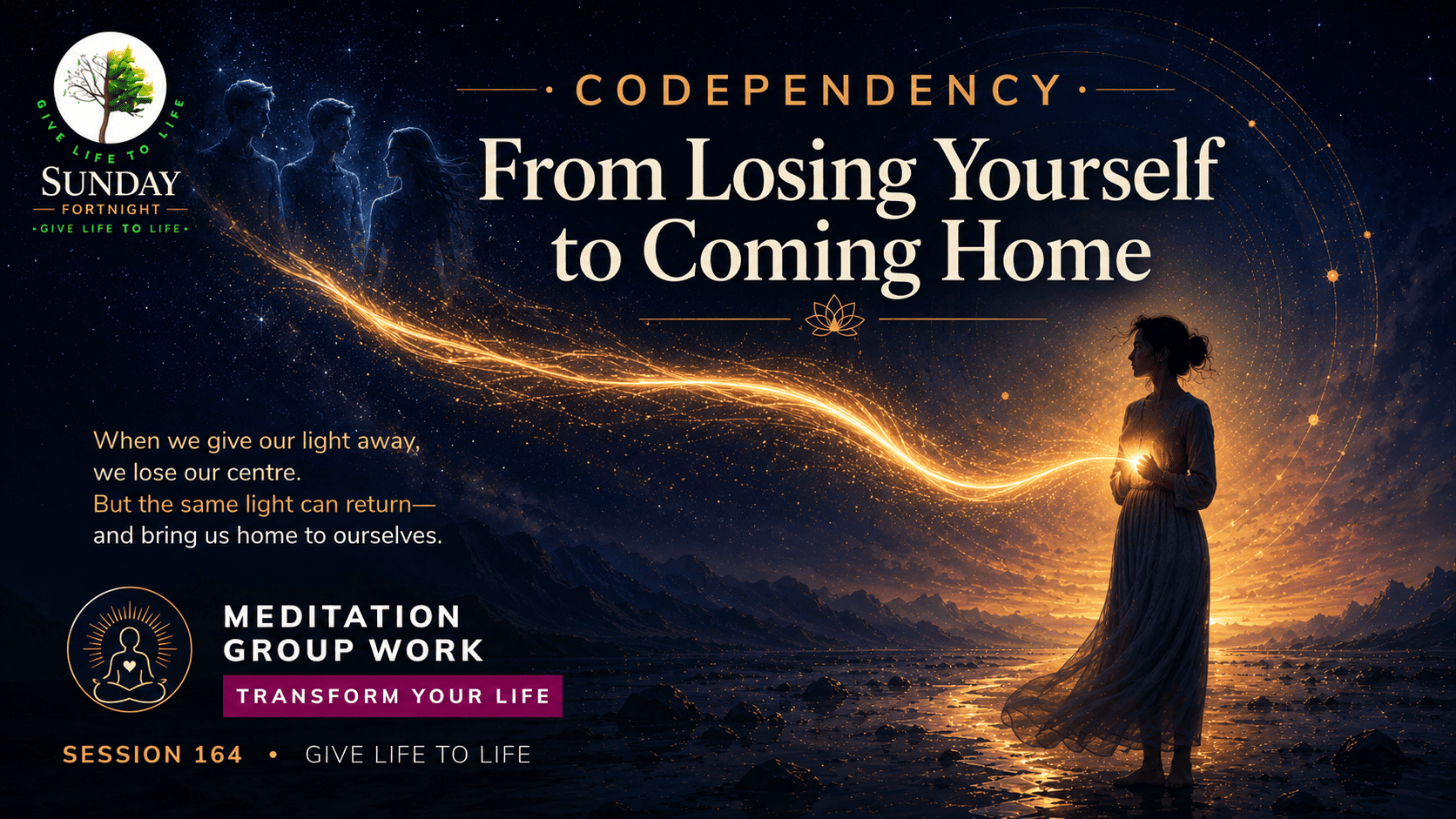
1 — Your attention left you, and went to live in someone else
Codependency is not caring too much. It wears many faces — the pleaser, the strong one, the anxious one, even the one who needs nobody — but underneath it is one single movement: attention that left home. The rooms change; the movement is the same. And recognising the movement, rather than judging the face it wears in you, is where the way back begins.
2 — Caring is not the wound. Vanishing inside the caring is
The question is not whether you care — it is where the caring flows from. When it flows from fear, of being left or of not mattering, it empties you. When it flows from fullness, it nourishes both of you. Same love, completely different source. Nothing in this work asks you to care less. It asks you to be present inside your caring.
3 — The pain and the belief have to go together — and only when something inside feels safe enough
Underneath old pain lives a belief that was formed with it — and if only the feeling is released, the belief keeps quietly choosing for us, and the pattern returns. That is why the release invites both, from the same place in the body. And the order matters: first being witnessed, then feeling safe, and only then letting go. If something inside said "not yet" on Sunday, that was not failure — it was wisdom, telling you its own pace.
Three Insights from this session’s worth sitting with
Real questions from Sunday's Q&A, shared here anonymously — because if one of you asked it, others are likely carrying the same question quietly.
Questions from the community
1 — When anger keeps rising every time you over-give
Q: An angry voice keeps taking over whenever I give too much of myself to others — is the anger the problem?
A: The anger is not the problem — it is protecting someone. It watches the one in you who keeps accommodating, keeps giving, keeps disappearing, and it grew loud precisely because you went missing. It is saying: "I am the one who is suffering here." When you turn toward the accommodating one, don’t be surprised if the anger floods in first — let it speak, it has earned that. And know this: the same story usually repeats across many moments and many ages, with one signature belief underneath, something like "I don’t matter — everything else matters more." That is why the guided work deliberately named no age. Each time you return, a different memory or a different age may come forward. Underneath them all, one root — and every visit reaches it a little more.
2 — Needing to pause and write everything down
Q: I have to keep pausing to write things down or I lose the connection — is something wrong with me?
A: Nothing is wrong with you. Something inside you is asking you to take this seriously — and that is a very good sign. The protective voices in us are opening a door to something precious they have guarded for years; they do not want it approached casually. Pausing the recording and writing things down is a very small price for removing that barrier. The pace of a live group is a limitation of the format — never a limitation of you. Take the recording, pause as often as you need, and let your inner world set the speed.
3 — Was my caretaking inherited, or learned?
Q: I have been the caretaker in my family since I was very small. Did I inherit this, or did I learn it?
A: It can be either — and it is worth asking inside which one is true for you. Sometimes what we carry is not ours at all: pain that belonged to our parents’ own childhoods, passed quietly into us. And sometimes it is a role a very young child took on through sheer repetition, day after day, until it became identity. The way it releases differs, so the question matters. And one more thing: if the protective voice in you refuses to step down, that refusal is legitimate. It is asking you to prove something — that safety for the little one inside can be created from within, rather than by managing and holding everyone on the outside. Meet that request with respect. It is not blocking your healing; it is guarding the terms of it.
4 — Why understanding alone doesn’t make the pattern stop
Q: I understand my patterns now — why won’t this protective voice simply step aside?
A: Think of a guard dog. A protection dog protects — no matter how much training you have done, no matter how much you understand about dogs. You don’t get rid of the dog. You make the one it protects safe. This voice will never be argued away, because arguments are not what it is waiting for. But it has already shown you the door: who it protects, since when, and what that one went through. Go there. Witness the younger one. Offer what was needed and never came. When the one being guarded is finally safe, the guarding softens on its own — not because it was defeated, but because its work is genuinely done.
5 — Does my healing change the people around me?
Q: If I do this work on myself, does it actually change anything in my family?
A: No one can promise how another person will respond. And yet, again and again, we see it: yes. Because when the story you carry inside changes, your words change, your tone changes, what triggers you changes — and the other person’s defences stop being activated in the same way. Almost every argument is one protective voice meeting another protective voice, each escalating the other. Shift one side of that loop, and the whole loop changes. One member shared that a long-estranged family member reached out again, unprompted, in the weeks after this deeper work. This pattern keeps two people in prison, not one — and when you step out, the door opens a little for the other person too.
Your practice this fortnight
Working with the session Recording:
The recording of this session is available through the community group and on this page. Fifteen minutes, once a day if possible — or a few times across the fortnight. Sit somewhere quiet with your object in your hand or nearby.
When you press play, you do not need to try to feel anything, or do it right. The only intention is to be present with whatever arises — and to meet it with a little more patience than you might usually offer yourself.
If the voice that watches over everyone feels a little more available now — go toward it, and let it speak. If the younger one feels closer — sit beside the younger one again, and ask what is needed today. If something said "not yet" on Sunday — simply keep visiting. Trust is built in returns, not in breakthroughs. And through the day, one small practice: whenever you notice your attention has gone to live in someone else, place a hand on your chest, take one breath, and say inwardly, "I am here." That is the whole practice. That is the walk home.
Somatic Recommendations
Shoulder rolls · morning and evening · let each roll be a small, deliberate act of setting something down
One small, unexplained yes to yourself each day · no justification needed, no audience required.
A few minutes of warm water — bath, basin, or simply your hands · no cost, no timing Slow movement, wherever you are