Session 159 · 6 Jun 2026 · Forgiveness
Inner work · Healing
You have spent a long time learning how to forgive other people. You have read the books. You have done the work. You have found your way — at least partly — toward some form of release for the people who hurt you, let you down, or left. But there is a forgiveness that almost no one talks about. The one you owe yourself.
This session turned toward the hardest kind of forgiveness — not toward anyone else, but inward. Toward the choices we made when we were under impossible pressure, without the tools we needed. Toward the moments we abandoned ourselves because we did not know another way. Toward the younger version of us who has been waiting, quietly, for someone to finally say: I understand why you did what you did. Given everything you were carrying — it makes sense.
What moved in the room was not a technique or a concept. It was the moment people began to witness their own story — not from the place of the inner judge, but from something quieter and much kinder. And in the Q&A that followed, something became visible that is worth sitting with: the verdict we carry against ourselves is often the last one we examine, and the one that has been doing the most damage.
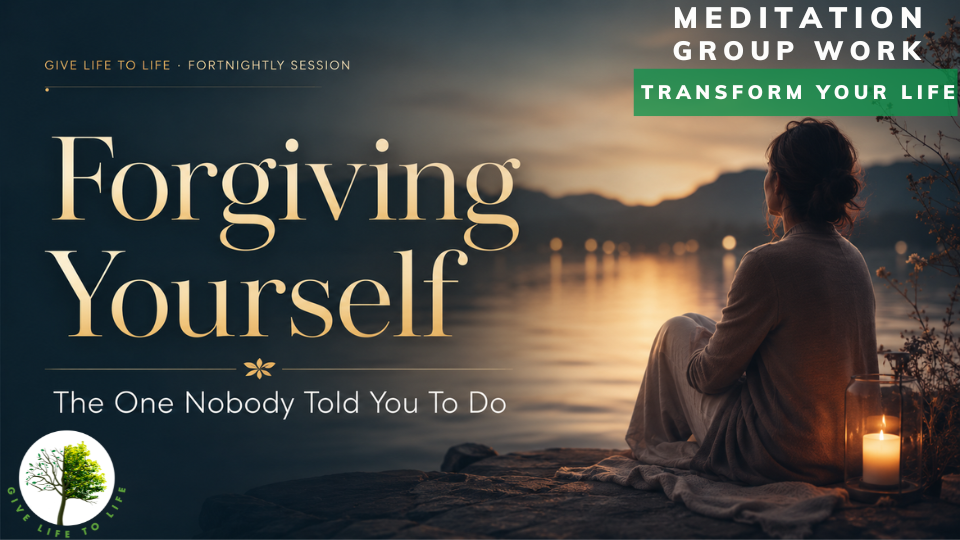
Forgiving Yourself: The One Nobody Told You To Do
Part 1
Teaching & opening meditation
• Welcome and grounding
• Opening meditation
• Psychoeducation
Starts at 00:00 (16 Min)
Part 2
Guided inner work & sound healing
• IFS experiential
• Sound healing
• Closing
Starts at 16:00 (48 Min)
Three insights from this session’s Q&A
1 — The inner judge is not the truth — it is a protection
There is a voice inside most of us that holds a steady, quiet verdict. It says: you should have known better. You had no excuse. You do not get to put this down. That voice sounds like the truth — firm, certain, relentless. But it is not the truth. It is something that formed, usually very early, to make sure you would never be caught off guard again. Its intention is protection, not punishment — but because it has been doing its job unchecked, it has become the harshest judge you will ever face. Harsher than any court, any critic, any person who actually hurt you. It applies a standard to you that it would never apply to another human being in the same situation. Recognising it as a protection — not a fact — is the first step toward loosening its grip.
2 — Holding both truths is how the verdict begins to change
One of the most powerful things that emerged in this session is something deceptively simple: you do not have to choose. What you did had real consequences — and the person who made that decision was younger, more alone, less resourced, and more afraid than the verdict has ever accounted for. Both of those are true. The moment you stop forcing yourself to choose between accountability and understanding — the moment you can hold them together — something that has been locked for years begins to move. This is not letting yourself off the hook. It is finally seeing the full picture instead of only the part the judge has been showing you.
3 — Witnessing is the act of forgiving
Self-forgiveness is not a statement you declare. It is not something you decide to do and then it is done. It is something that happens — quietly, in the body — when you finally turn toward your own story with the same compassion you would offer anyone else. When you sit beside the younger version of you and let them show you what it was actually like — what they were carrying, what they were afraid of, what they believed they deserved — without turning away. What the community experienced in this session is that the act of witnessing, genuinely and without judgment, is itself the act of forgiving. You do not need to say the words. You need to stay.
Your practice this fortnight
The recording from this session is available. Thirty minutes, once a day if possible, or a few times across the fortnight. Use the IFS Session Part.
Sit somewhere quiet. Find the object you used during the session — or anything small and solid that fits in your hand. Let it ground you before you begin.
When you press play, there is nothing to do right. The only intention is to go back to the two places we visited: the voice that has been holding the verdict, and the younger version of you underneath it.
With the voice — simply check in. How is it today? Has anything shifted? Let it know you are still listening.
With the younger one — go back. Not to work on anything. Just to be present. Let them know that Sunday was not a one-time visit. You can offer again, in your own words or simply as a feeling: I see you. I understand. I am not going anywhere.
If the inner judge returns — and it will — notice it without merging with it. You can hold your object and remind yourself: that is the voice. I am not the voice. I am the one who is here.
There is no need to force anything further. What you touched in this session is already in motion. Let it work at its own pace.
Somatic Recommendations
Salt bath · 200g · 20–30 minutes · no phone
Slow walk in nature · no destination · no timing
Working with the session recording