Session 158 · 24 May 2026 · Forgiveness
Inner work · Healing
Most of us have been told at some point that we should forgive. That holding on is hurting us more than them. That letting go is the path forward. And yet something inside won't budge — or quietly knows that the forgiveness offered wasn't quite real. Or isn't even sure, when it sits still long enough, who it is that actually needs forgiving first.
This session turned toward all three of those situations at once. The one who cannot forgive. The one who forgave too soon — who said the words, closed the door, and bypassed something that was never actually met. And the one who is waiting, quietly, to extend some forgiveness toward itself. Whatever door felt most alive for you — that was the right place to begin. And the recording is here for you to return to, as many times as this needs.
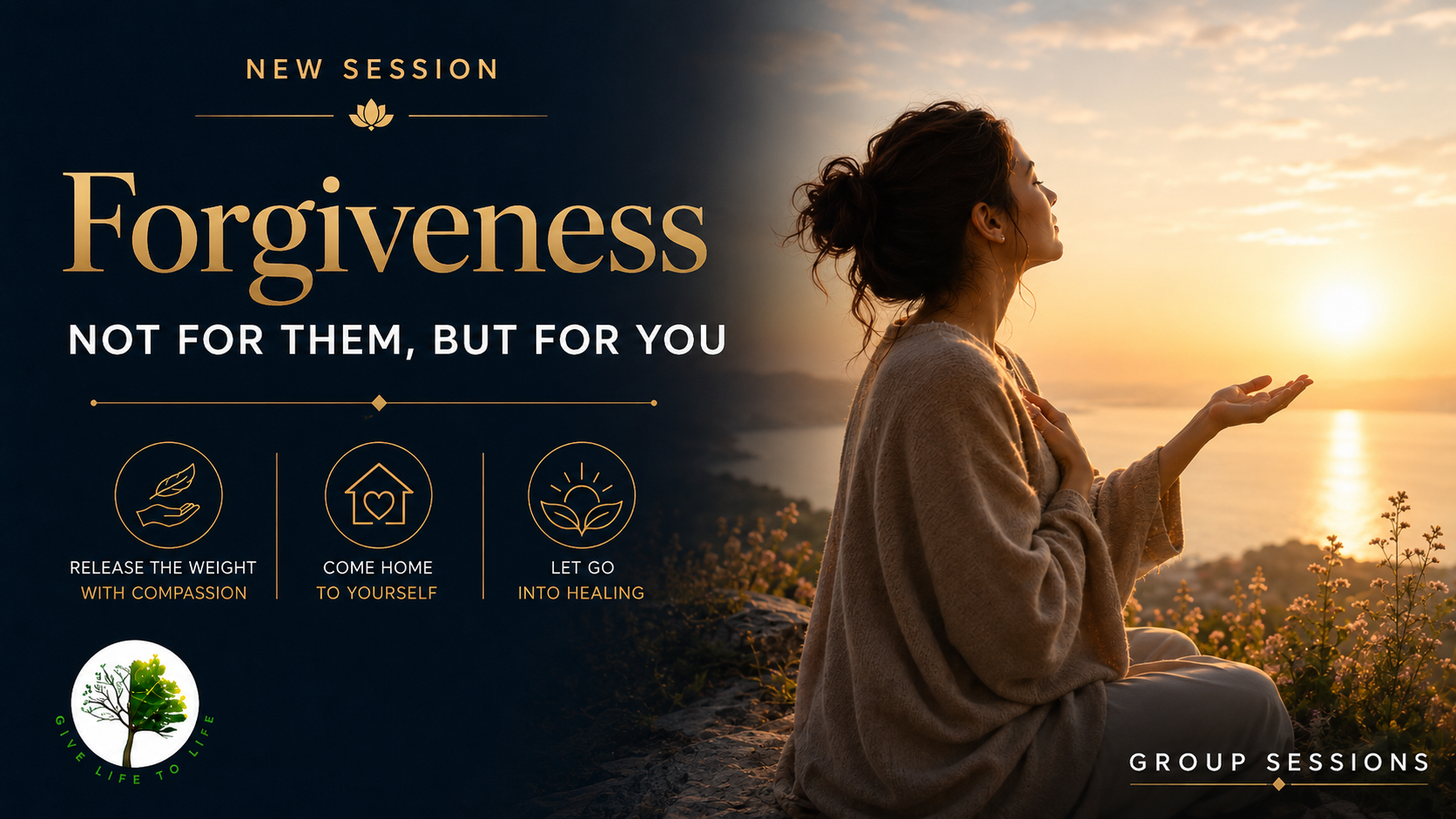
Forgiveness - Not for Them, But for You
Part 1
Teaching & opening meditation
• Welcome and grounding
• Opening meditation
• Psychoeducation
Starts at 00:00 18 Min
Part 2
Guided inner work & sound healing
• IFS experiential
• Sound healing
• Closing
Starts at 18:00 44 Min
Eight things from this session’s Q&A worth sitting with
1 — There is a difference between being the pain and seeing the pain
Something that came up clearly in the Q&A was the distinction between becoming the wound and being able to look at it. When someone is so merged with what they are carrying — the fear, the grief, the blame — they are no longer able to help it, because there is no longer a witness. There is only the feeling. The shift begins in the moment of separation: not I am afraid, but something in me is afraid. Not I am the one who was hurt, but I can see the one who was hurt. That small change in language is not a trick. It is the beginning of the relationship that makes healing possible.
2 — Self-forgiveness is the one nobody warns you about
In almost every forgiveness framework — spiritual, cultural, therapeutic — the focus is on forgiving the person who caused the harm. What came up in this session, again and again, was the quiet injury underneath that: the younger one inside that was never asked to forgive itself. For abandoning its own needs. For choices made under impossible pressure. For staying too long, or leaving too soon, or not speaking when it mattered. This is the forgiveness that most exercises skip entirely. And that younger one can be quietly furious that it was bypassed. Hearing that fury, before asking it to release anything, is where the real work begins.
3 — Premature forgiveness leaves something untouched
What also surfaced was the experience of having forgiven — genuinely believing it was done — and then discovering that something underneath had never actually moved. It had been bypassed. The words were said, the understanding was reached, the decision was made. But the younger one inside was never consulted. Never witnessed. Never given the chance to express what it actually needed. When this happens, the forgiveness sits on the surface while the wound remains exactly where it was left. Returning to that younger one — with no agenda, no pressure to release — is what the bypass made impossible the first time.
4 — Panic and urgency from the body are not random — they are signals
Something that came up was the experience of waves of physical fear or panic that seem to arrive without warning — with no clear thought or memory attached. What emerged in the discussion was that these responses are rarely random. They are almost always a younger wounded place trying to be heard. The signal arrives in the body precisely because it cannot yet find words. Rather than trying to stop the signal, the invitation is to get curious about it — to step back far enough to ask what it is trying to say, rather than becoming it. A somatic pause can help create enough space to do that.
5 — The voice that refuses to forgive may actually be a guide
One of the most striking moments in the Q&A was when someone discovered that the voice holding back forgiveness — the one that had been seen as the problem — was actually something fiercely intelligent. Something that had been watching, recording, holding the account of what happened when no one else would. When it was finally given space to speak without pressure to change, it shifted into something altogether different: a guide, a compass, an internal ally that knew exactly what had been unjust and exactly what mattered. The protector, fully heard, became something entirely different from what it appeared to be.
6 — Inherited pain needs its own process
Something that came up for more than one person was the recognition that what they were carrying was not entirely their own. Patterns passed down through family — the tendency to take blame, the belief that good things are not possible, the hypervigilance to signs of criticism — had been absorbed at an early age and were still running, often indistinguishably from what felt like their own character. The specific inner work for this kind of pain is different: it involves recognising what belongs to the lineage, and allowing it to be returned — not as an act of blame, but as a release of what was never meant to be carried by this generation alone.
7 — Grieving and forgiving are not the same thing — but they are linked
What emerged in the conversation was that for some people, the block to forgiveness is not anger but grief — a sadness so heavy it becomes immobilising. The insight that came through was that grieving has its own sequence, and trying to skip it in order to arrive at forgiveness is another form of the bypass. The grief needs to be witnessed first. And what can sometimes help is not only sitting with the loss, but also asking what qualities were taken away by the wound — joy, freedom, lightness, trust — and beginning to invite those back. That invitation does not erase the pain. But it gives it somewhere to go.
8 — Trusting the body's signals, even when the mind resists
Something quiet but significant was shared near the end of the session: the experience of arriving with resistance — not wanting to be in a forgiveness session, not believing it was relevant — and then noticing, during the sound healing, that something had shifted without any decision being made. Physical heaviness beginning to lift. A sense of peace arriving unexpectedly. What this points to is something the mind cannot always access: that the system inside us has its own intelligence, its own timing, and its own way of responding to being witnessed — even when the thinking part is still uncertain. Learning to notice those signals, rather than override them, is itself a form of the work.
This is a condensed version of Sunday's inner work — designed to help you stay connected to what you touched in the session without needing to start from scratch.
Find a quiet moment. Morning works well but any time is fine.
Your object Before you press play — find the object you used on Sunday. A stone, a ring, anything small and solid that fits in your hand. Hold it as you listen.
Mid-Week Check-In
Your practice this fortnight
Your practice this fortnight
The recording of this session is available through the community group and on this page. Thirty minutes, once a day if possible — or a few times across the fortnight. Sit somewhere quiet with your object in your hand or nearby.
When you press play, you do not need to try to feel anything. You do not need to do it right. The only intention is to be present with whatever arises — and to meet it with a little more patience and compassion than you might usually offer yourself.
If the voice that held back on Sunday feels a little more available now — go toward it. If the younger one feels closer — sit beside the younger one again. And if nothing moves — that is also a completely valid response to work this deep.
Somatic Recommendations
Salt bath · 200g · 20–30 minutes · no phone
Slow walk in nature · no destination · no timing
Working with the session recording