"Your pain can become your purpose. But only if you tend your garden daily."
You've cleared the space. You've planted new seeds. You've strengthened your roots. Now comes the question everyone asks:
What happens when life gets hard again?
This is where you learn the daily practices that keep you healed—and help your fruit overflow to others.
This is your reset button. Your way of life.
Step 5 isn't about reaching a finish line or achieving perfect healing.
It's about building daily practices that prevent new experiences from becoming new trauma.
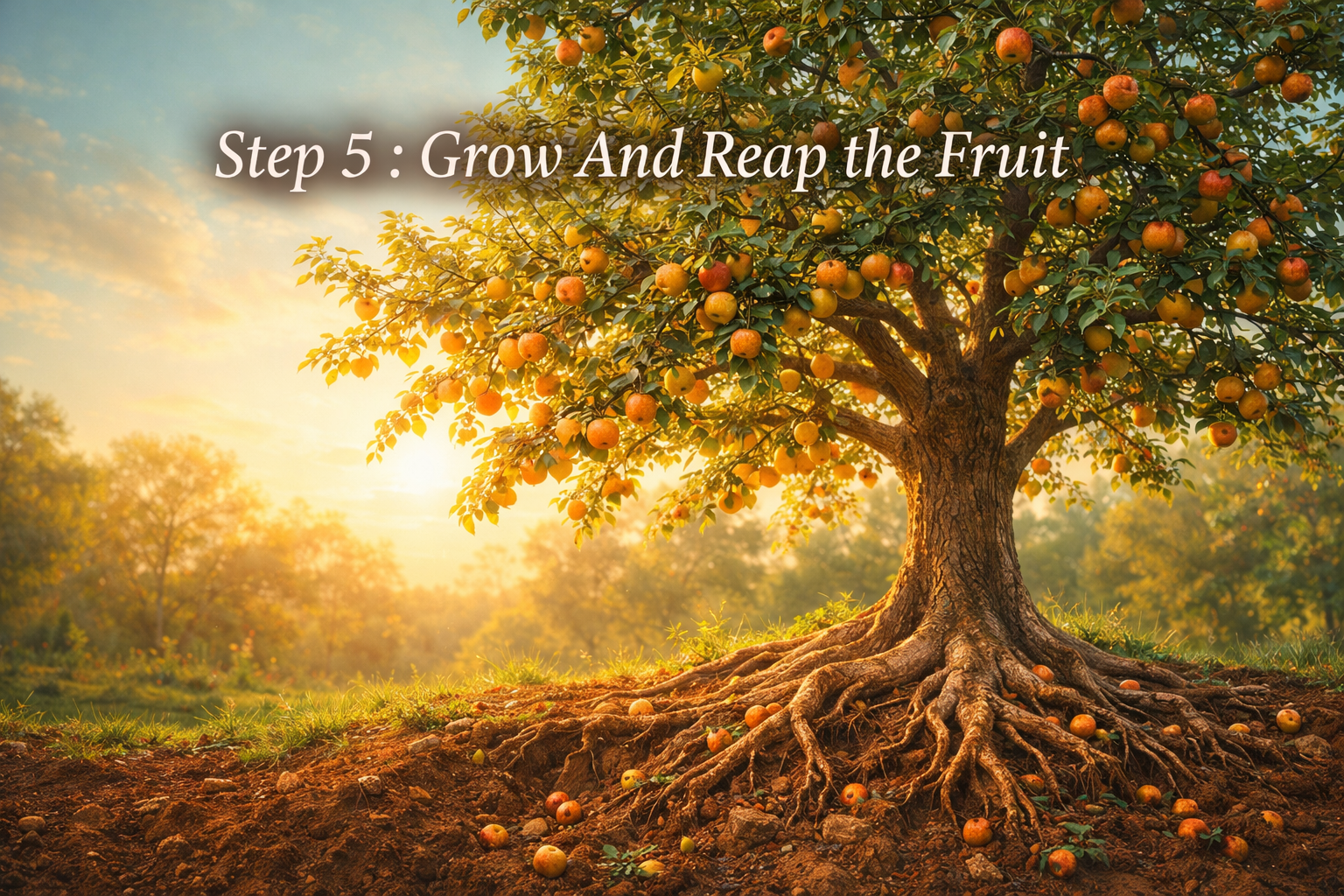
Think of it like this: You've grown a tree in your garden. It's strong now. Rooted. But trees don't grow once and stop.
They grow in seasons. They bear fruit. They shed what they don't need. They root deeper each year.
And they continue to be tended.
You don't plant a tree and walk away forever. You water it. You check in with it. You notice when something's off.
Step 5 is that daily tending—the practices that ensure your transformation lasts.
In this step, you'll practice five daily rituals:
MORNING CHECK-IN — Connect with your inner world before the day starts (5 min)
BREATHWORK — Ground your nervous system (5 min)
VISUALIZATION — Keep your North Star alive (5 min)
GIVING BACK — One small act of service daily (5 min)
EVENING REFLECTION — Process the day + meditation (10 min)
When you complete this step, you'll have a sustainable practice that keeps you healed, helps you process new challenges before they become trauma, and naturally leads to overflow—where your cup is so full you can't help but give back.
What Happens If You Skip This Step
Without daily practices, you bounce.
Things look good for a while. You feel hopeful. Energized. Alive.
Then something happens—a setback, a crisis, a new stressor—and you go back down.
Not because the healing didn't work. But because you didn't have a reset button.
And here's what I've seen hundreds of times:
People do Steps 1-4 beautifully. They clear old wounds. They set their North Star. They work with resistance.
But then life happens. A relationship ends. A job falls through. A family crisis hits.
And without daily practices to process it, the experience doesn't discharge—it compounds.
Layer by layer. Until they're back where they started.
They think: "I guess I'm just broken. The work didn't stick."
But the work did stick. They just didn't tend the garden.
What Happens When You Do This Step Well
ou learn to process life like Pathway 1 instead of Pathway 2.
Pathway 1 (Process and Release): Something stressful happens. You notice it. You breathe. You check in with your inner world. You let it discharge. It's over. No residue.
Pathway 2 (Replay and Reinforce): Something stressful happens. You grip. You replay. You tell the story over and over. Each time, the experience reinforces. It doesn't discharge—it becomes new trauma.
And people who complete this step report:
Ability to recover faster from setbacks (research shows 40% faster recovery speed)
Processing challenges without spiraling
Staying grounded even when life is hard
Leading their inner world instead of being led
Life feeling precious again (gratitude overflows naturally)
Wanting to give back (not from obligation, but from overflow)
Reaching the "10,000-foot view" — seeing their pain as an opening
Because they're not just healed.
They're living in a way that maintains the healing.
Part 1: The Daily Practices That Keep You Growing
Five simple rituals (30 minutes total) that become your reset button:
Morning (20 minutes):
Check-In with Your Inner World (5 min) — Most important practice of all. Ask: "How is my inner world today?" Notice which voices show up. Thank them.
Breathwork (5 min) — Box breathing. Regulate your nervous system. Ground yourself.
Visualization (5 min) — Continue Step 3 practice. Keep your North Star alive.
Giving Back (5 min) — Ask: "What's one small thing I can do today to help someone?" Set the intention.
Evening (10 minutes):
Reflection + Meditation (10 min) — Which voices got activated today? Thank them. Then sit in silence. Observe your thoughts without being controlled by them.
As-Needed (Not Daily):
Forgiveness — When resentment or self-blame shows up. Usually toward your younger self.
Part 2: The Overflow—Giving Back
When you've tended your garden so well that fruit is growing, something shifts.
You stop asking: "Why did this happen to me?"
And you start asking: "What can I do with what I've learned?"
This is when giving back stops being a practice and becomes inevitable.
The person drowning in burnout becomes the mentor.
The person who couldn't imagine healing becomes the guide.
The person who thought they'd never escape becomes the one who holds space for others.
Not because they're trying to be noble.
But because when your cup is so full it spills over, you can't help it.
That's the overflow. That's what happens when you reach Step 5.
The 10,000 Foot View
When your Narrative Changes
There's a moment in healing that's hard to describe.You're going about your day, and suddenly you find yourself thinking about what happened to you. The trauma. The pain. The thing you thought would break you.
And you realize: you're not looking at it from inside it anymore.
You're looking at it from 10,000 feet up.
Trauma is when you stay in the narrative at the point where the pain began.
You keep replaying it. Reliving it. Seeing yourself as the person it happened to.
Healing is when you can change that narrative.
Not by pretending it didn't happen. Not by minimizing it.
But by zooming out. By going 10,000 feet up and asking:
"What did this experience make possible? What did I learn? Who did I become because of it?"
Most of the time—not always, but most of the time—challenges are openings.
Not because the pain was necessary.
But because when you've been through something difficult and done the work to heal from it, you gain something that can only be earned through struggle.
Compassion. Wisdom. Strength. Depth.
But you can't see that from inside the pain.
You have to go up. You have to get perspective.
That's the 10,000-foot view. And that's when you know: your pain became your purpose.

Get the complete Step 5 practice guide with all five daily rituals, 45-day tracking log, and forgiveness practice
This worksheet includes: Morning routine template, evening reflection template, 45-day tracking log, practice details for all 5 rituals, forgiveness practice (as-needed), and troubleshooting guide.
This 25-minute guided practice walks you through your complete morning routine:
Parts check-in → Breathwork → Visualization → Giving back intention. Use this every morning for the first 30 days until the practices become automatic. Press play.
In this 10-minute video, Manu explains:
How to know when you've truly healed (the 10,000-foot view)
Why most people bounce back to old patterns (they don't have a reset button)
How these five daily practices prevent new trauma
When pain becomes purpose (and how to get there)
Your Daily Practice
(Morning & Evening)
Morning (20 minutes):
Check-In with Your Inner World (5 min)
Before your phone, before coffee. Sit quietly. Ask: "How is my inner world today?" Notice which voices show up. For each one: "What are you worried about? What do you need from me?" Thank them.Breathwork (5 min)
Box breathing: Inhale 4, hold 4, exhale 4, hold 4. Repeat. With each exhale: "We're safe. We can relax."Visualization (5 min)
Visualize your North Star (from Step 3). See yourself living that life NOW. Feel it in your body. End with: "Thank you for this life." (Present tense)Giving Back (5 min)
Ask: "What's one small thing I can do today to help someone?" It doesn't have to be big. Text a friend. Hold a door. Really listen. Set the intention.
Evening (10 minutes):
Reflection + Meditation (10 min)
Part A (5 min): Which voices got activated today? Thank them. Reassure any that are still worried.
Part B (5 min): Sit in silence. When thoughts come, notice them. Label them if helpful. Return to your breath.
As-Needed (Not Daily):
Forgiveness
When resentment or self-blame shows up. Usually toward your younger self.
Say: "I see you. You did the best you could. I forgive you. You're free."
Why These Practices?
Research shows:
Regular check-ins with inner world reduce depression/anxiety by up to 40%
Breathwork reduces cortisol by 25%
Visualization activates same neural pathways as real experience
Acts of kindness improve mental health comparable to therapy
Meditation increases gray matter in empathy/stress regulation regions
Why 45 Days?
Days 1-14: Practices feel mechanical, you're building the habit
Days 21-35: They start to feel natural, you crave them
Days 36-41: They become automatic
Days 42-45: You can't imagine life without them
Troubleshooting - Step 3 (Plant the Seed)
-
Start with Practice 1 only. 5 minutes. Just the morning check-in. Build from there. Better to do ONE practice consistently than five sporadically.
-
Anchor them to existing routines. Check-in before phone. Breathwork after coffee. Build new habits onto what you already do. If you miss one day or other, be kind to yourself.
-
Normal at first. Around Week 3, they feel natural. By Week 6, you'll crave them. Your inner world needs time to trust: "This is safe."
-
You didn't fail. You learned what it feels like to tend your garden, and what it feels like when you stop. Start again. The practices are always here.
-
That's okay. Giving back isn't required. It's what happens when your cup overflows. Focus on Practices 1-3. The overflow will come when it's ready.
-
The practices don't eliminate hard times. They help you move through them without getting stuck. Did you recover faster? Did you spiral less? That's progress.
How to Know This Step Is Working
ou'll know this step is working when:
✓ You process life differently
New challenges don't become new trauma. You move through them like Pathway 1 (discharge) instead of Pathway 2 (compound).
✓ You recover faster from setbacks
Research shows resilience practices lead to 40% faster recovery. You still experience stress, but you bounce back quickly.
✓ Your inner world trusts you
Voices show up, but they don't run your life. They know you're listening. They know you're leading.
✓ Life feels precious again
Small things matter. A morning cup of coffee. A conversation with a friend. Sun on your face. Gratitude overflows naturally.
✓ You want to give back
Not from obligation. From overflow. Your cup is so full you can't help but share it.
✓ You've reached the 10,000-foot view
You can see your pain as an opening. You can say: "That happened. It was hard. And because I went through it, I'm able to help others now."
✓ You catch yourself leading your life
Instead of reacting, you're choosing. Instead of being pulled, you're guiding. You're home in your own life.
Post Trauma Growth
(THE RESEARCH)
Most people know about PTSD—post-traumatic stress disorder.
But fewer know that trauma can also lead to profound growth.
Research by psychologists Richard Tedeschi and Lawrence Calhoun identified five areas where people report growth after trauma:
Greater appreciation for life — Things that seemed mundane become precious
Deeper relationships — Superficial connections fall away; authentic ones deepen
Increased personal strength — "If I survived that, I can handle this"
New possibilities — Paths you never considered suddenly open
Spiritual development — Sense of meaning, purpose, connection to something larger
Post-traumatic growth doesn't mean the trauma was "worth it."
It means: When you do the work and tend your garden daily, something unexpected grows.
Not just healing. Transformation.
AFTER 90 DAYS : You Have Complete all 5 Steps
Once you've completed Step 5—once you've built the daily practices, once you've tended your garden for 90 days, once your fruit is overflowing—you've completed the entire five-step process.
You've done the work:
✓ Step 1: Mapped your garden
✓ Step 2: Cleared the weeds
✓ Step 3: Planted new seeds
✓ Step 4: Strengthened the roots
✓ Step 5: Growing and bearing fruit
But here's the secret:
This isn't a one-time journey. This is how you live.
You'll return to these steps again and again—not because you failed, but because life is seasonal.
New challenges will come. New voices will get activated. New layers will ask to be cleared.
And each time, you'll have these tools.
You'll know your garden. You'll know how to clear it. You'll know how to plant. You'll know how to strengthen. You'll know how to tend.
This is what it means to be whole:
Not perfect. Not problem-free. Not without pain.
But able to meet life with curiosity, compassion, and calmness toward your inner world.
And when that overflow happens—when your cup is so full it spills over—you'll know exactly what to do with it.
You'll give it back.