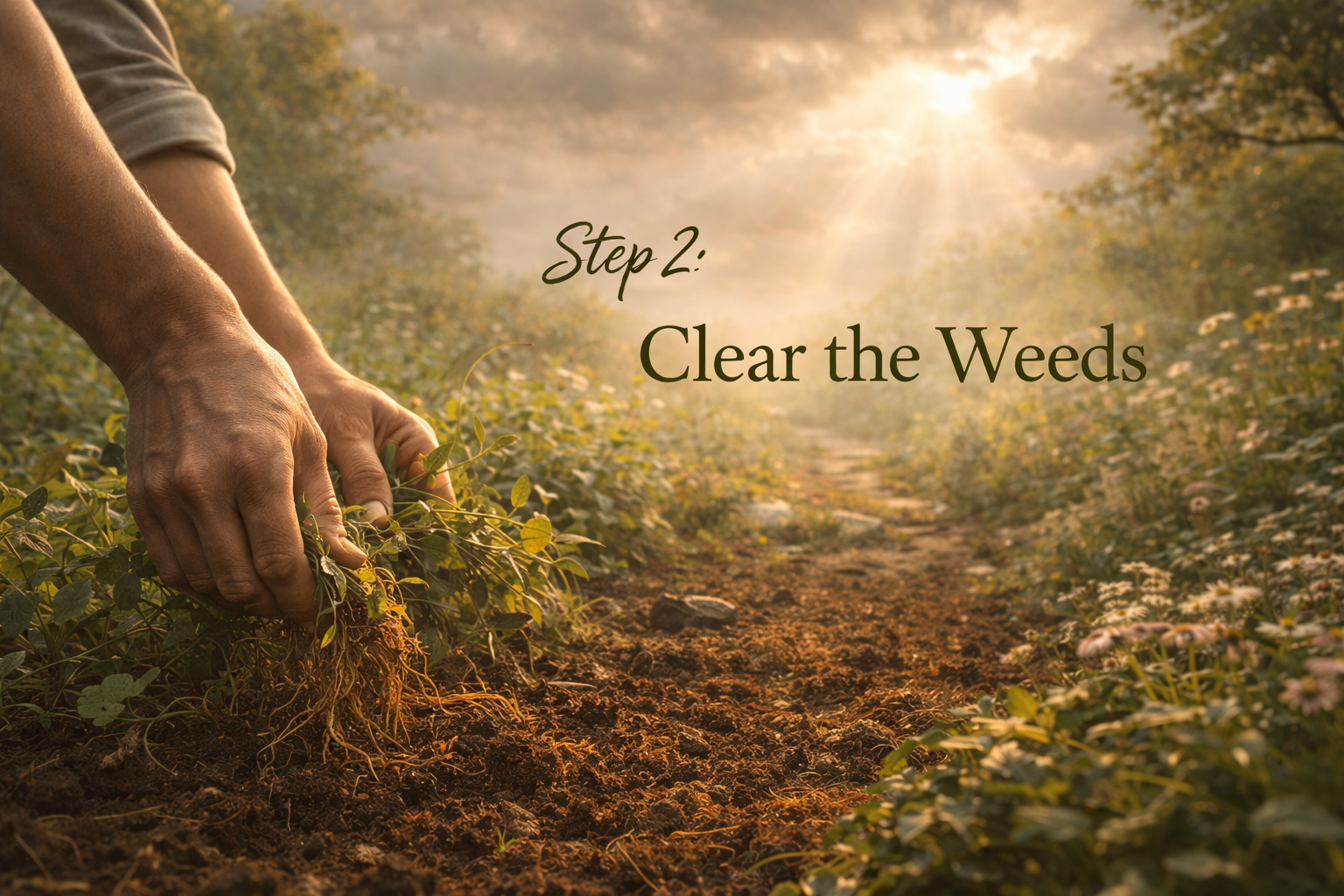
"They protected you then. They're limiting you now."
Most people skip this step because it feels too hard. But here's the truth: you can't plant new seeds in soil that's still full of old roots.
This is where real healing happens—not by fighting yourself, but by listening to what's been held inside all these years.
What "Clear the Weeds" Really Means
This step is about releasing what you've been carrying—the overwhelming emotions from long ago that your body never fully processed.
When something too big happened when you were young, your system created protections: numbness, perfectionism, people-pleasing, hypervigilance, independence.
Those protections saved you then.
But now? They're running your life from an old reality that no longer exists.
In this step, we work with three things:
The protective responses — What you automatically do when life gets hard (the responses you identified in Step 1)
What they're protecting — The overwhelming emotion that didn't feel safe to feel back then (grief, fear, anger, shame)
The younger version of you — The one who first needed that protection, still holding what happened
When you help that younger version release what it's been carrying, the protective responses can finally relax.
What Happens If You Skip This Step
I've watched it hundreds of times.
People do Step 1, get clarity, feel hopeful.
Then they jump straight to Step 3—setting goals, making plans, moving forward.
And it works... for a while.
Then three months later, six months later—everything comes back.
The anxiety. The overwhelm. The old pattern.
Because they tried to plant new seeds in soil still full of old roots.
What Happens When You Do This Step Well
You stop just understanding your pattern.
You actually release it.
And people who do this work report:
Chronic pain disappearing
Migraines stopping after years
Sleep improving dramatically
Relationships healing
Energy returning
Life feeling possible again
Because they didn't just know what was wrong.
They cleared the root.
Before You Begin: The Two Essentials
This work requires two things to be safe and effective:
1. Being present without being overwhelmed
When you're flooded by emotion, you've become it—you can't see anything else.
But when you can be WITH it without disappearing into it—when you can say "I'm noticing anxiety in me" instead of "I am anxious"—you create the space where healing becomes possible.
This isn't pushing it away. It's staying connected while still being able to breathe.
2. Approaching with curiosity and compassion
Once you can be present, you can ask:
"What are you protecting me from?"
"Since when have you been doing this?"
"What do you need me to know?"
Not interrogating. Not judging.
Just genuinely curious.
Because whatever this response is doing—however much it hurts now—it started as an attempt to keep you safe.
When both of these are present—presence and curiosity—healing becomes possible.
What You Can Do On Your Own
The awareness practice below helps you:
Notice where this protective response shows up (body/image/voice/numbness)
Understand what it's protecting you from
Discover when it first started ("since when")
Build a compassionate relationship with it
What this practice does NOT do:
It doesn't go deep into trauma or try to force release. That deeper work should be done with an IFS-trained practitioner.
Think of this practice as building the relationship and identifying what needs healing.
The actual release work comes with professional support.

Get the complete Step 2 worksheet with the full practice, prompts, and space for reflection.
This worksheet guides you through the awareness practice with detailed instructions and journaling space.
This 12-minute guided practice walks you through building awareness and relationship with what you're carrying—without going into overwhelming territory.
Find a quiet space. Grab your journal. Press play.
In this 6-minute video, Manu explains why clearing the roots is essential for lasting change—and what happens when people try to skip it.
Ready to Go Deeper?
The awareness practice helps you identify what needs healing.
The actual release work should be done with an IFS-trained practitioner.
IFS (Internal Family Systems) is specifically designed for this work. It's gentle, properly paced, and doesn't retraumatize you.
You especially need IFS support if:
✓ The "since when" practice revealed early childhood (under age 10)
✓ The trauma involves abuse, violence, or significant loss
✓ You have a history of complex trauma
✓ You dissociate or feel disconnected from your body
✓ The pattern is severely impacting your ability to function
✓ You feel unsafe or overwhelmed doing this work alone
Finding an IFS practitioner:
Look for someone who is IFS-trained (ideally Level 2 or 3). You can find practitioners at the IFS Institute directory or through referrals.
[Find an IFS Practitioner →]
Troubleshooting - Step 2 (Clear the Weeds)
-
You don't have to go there all at once. This work is done in layers. You only go as deep as your system can handle. If something feels too big, stop and get support.
-
There's a difference between understanding trauma and releasing it. If your previous work was only cognitive (talking, understanding), it might not have touched the emotional charge held in your body. This work is somatic—it works with the body, not just the mind.
-
Numbness is itself a protection. If you can't feel, work with that. Ask: "What is this numbness protecting me from?" Sometimes the work is simply creating enough safety that feeling becomes possible again.
-
Emotions are like waves. They rise, peak, and pass. If you allow yourself to feel in a safe, contained way—with support, grounding practices, breaks—the feelings move through. It's actually the NOT feeling that keeps them stuck.
How to Know This Step Is Working
You'll notice:
✓ Physical release — Chronic tension eases, pain shifts, breath feels deeper
✓ Emotional access — You can feel again, not just hard feelings but joy and connection
✓ Pattern interruption — The automatic response doesn't trigger as easily
✓ Memory shifts — Past events don't carry the same charge; they're memories, not wounds
✓ Energy returns — The exhaustion lifts, you have capacity you didn't before
✓ Relationships improve — You're less reactive, more present
✓ Future feels possible — You can imagine a different way of being
Ready for Step 3
(Plant New Seeds)?
Once you've begun to clear the weeds—once you've started to release what was holding you back—you're ready to plant something new.
Not as pressure. Not as performance.
But as a seed. A direction. A vision. A future worth living into